Fancy's Monster
On the Time-Loop Origins of Mary Shelley’s Frankenstein

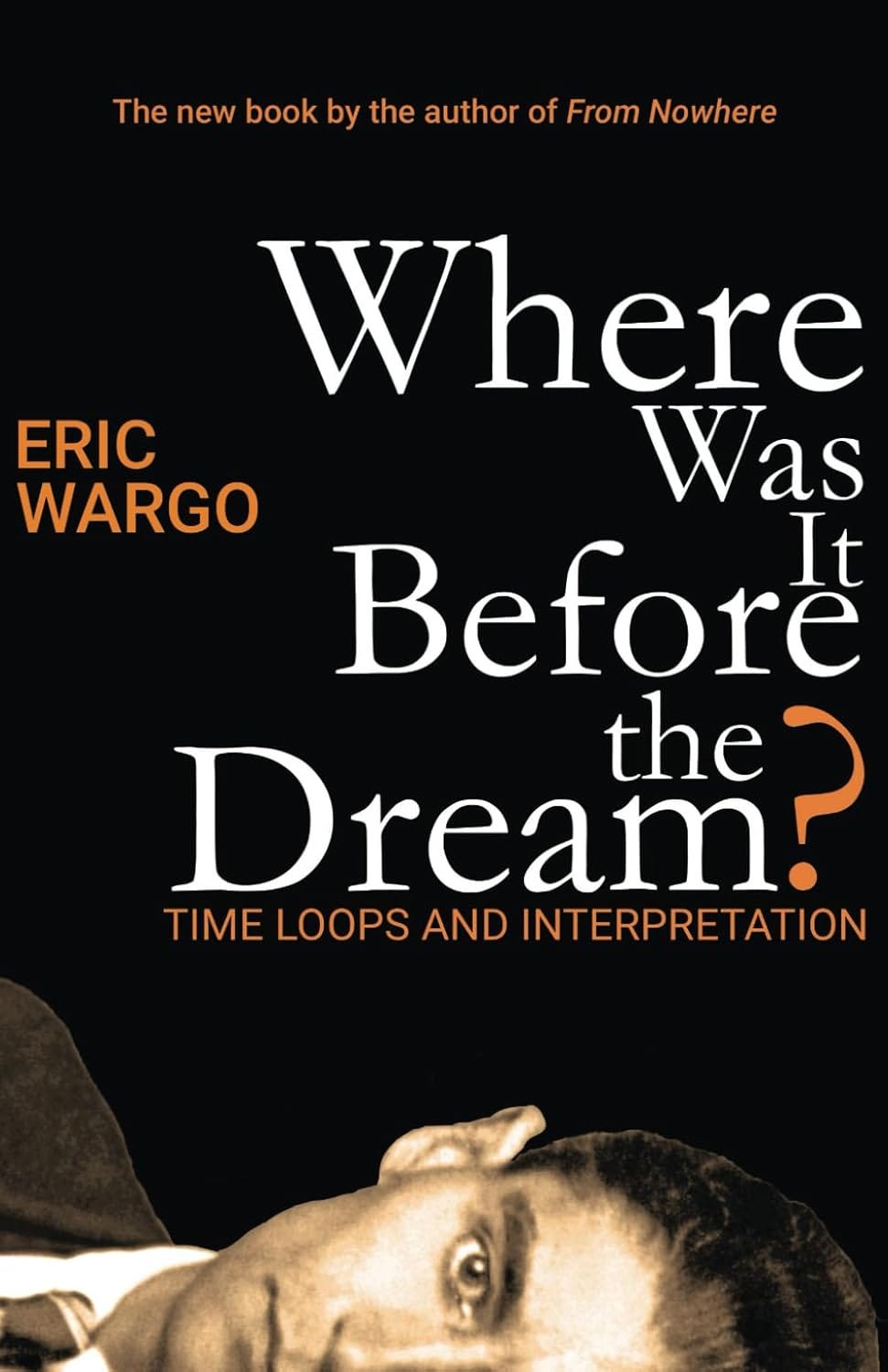
Precognition lies at the root of creative inspiration. My new book, Where Was It Before the Dream?, applies the idea of time loops to literary criticism, examining works by J. R. R. Tolkien, Franz Kafka, Stanislaw Lem, and other imaginative writers through the lens of “psychic deconstruction.”
With Halloween imminent and a new Guillermo del Toro film adaptation of Frankenstein about to hit theaters, I am making the following chapter on Mary Shelley’s inspired novel available to my Substack readers. Enjoy!
According to the associationist psychology of the 18th-century English philosopher David Hartley, there is nothing that comes out of the creative process that isn’t really some transformation of what went into it. A new idea is only original the way a certain configuration of balls on a billiard table is original. It may be the first time they’ve been arranged that way, the arrangement may be brilliant, but they got into that position from hitting each other in a sequence that can always be traced back to some earlier arrangement and some particular application of force through work. Poetic creation, in this view, can be largely reduced to “fancy.”
Hartley’s reductive, disenchanting view followed naturally from the mechanistic physics and biology of the Enlightenment. But the sciences were not the sole or ultimate drivers of what we now call mechanistic materialism—the rise of the physical sciences was a function of the social and economic forces that were rapidly reshaping social life. Physics came out of industrialism, not the other way around. Physicists sought to understand forces in the context of machines that were rapidly amplifying the power of human labor and were beginning to generate unprecedented wealth for the new capitalist class. Even today, there is a strong echo of that 18th-19th-century industrial context in how we talk about physical reality. Energy is still defined in many physics and chemistry textbooks as the ability to do work. Work is not meaningless activity—running around and playing. It has an objective and a purpose, it is a productive activity valuable to the individual, to the community, and to the owners of the means of production, in Karl Marx’s famous phrasing.
Profits are made in capitalism by keeping strict accounts, and this accounting logic is implicit in how causality itself is usually understood. In physics, to say a thing is caused is to give an accounting of the materials used and the labor put into assembling that outcome, with as little unaccounted remainder as possible. In Enlightenment scientists’ balancing of nature’s books, what came out—some effect—was assumed to be proportional to what went in. This assumption held for two centuries at least, but it turned out to be wrong. The discovery early in the 20th century that there was a remainder at the smallest scales in nature—the famous randomness or uncertainty that prevails in the quantum realm—was the first monkey wrench thrown into the Enlightenment scientific machine. It may in fact turn out that the unpredictable element in nature really reflects the component of causation that is backwards, propagating from the future toward the past—the physical basis for precognition.
The real fear about artists in a Protestant, capitalistic society is that they’re slackers and thieves. It’s that fear, I think, that gives rise to the sour truism constantly invoked to minimize artistic inspiration, Thomas Edison’s quip that genius is “one percent inspiration, and ninety-nine percent perspiration.”
To the extent that literary interpretation remains focused on finding all the receipts for a work’s influences, it retains the materialist mentality of 19th century capitalism. Like the physics of the Industrial age, it eschews uncertainty or anything even weirder. Fearful of discontinuity, some critics seem satisfied only when all possible influences on a work are accounted for, lest there be any hint of creation ex nihilo—something gotten from nothing. For that, I believe, is the real fear about artists in a Protestant, capitalistic society: that they’re slackers and thieves. It’s that fear, I think, that gives rise to the sour truism constantly invoked to minimize artistic inspiration, Thomas Edison’s quip that genius is “one percent inspiration, and ninety-nine percent perspiration.” The right context, a favorable disposition, persistence at a well-practiced craft, and simple hard work are what matters. Forget the magic of those ideas that come to the artist unbidden, out of the blue, or in a dream. Doubly forget any notion that those ideas might come from somewhere else than the artist’s past.
My premise is that a truly inspired work really is much more than the sum of its billiard-ball influences. No amount of accounting for past influences, whether in the realm of culture or even in the individual’s own life (childhood traumas, etc.), can explain or account for artistic or poetic originality. The books don’t balance, and it’s not because the writer is a thief—even though that remains an anxiety in the lives of many of them. Really, we must look to the writer’s future for that answer of “why?”: Why were specifically those influences selected out of all possible influences, and why were they arranged in that particular way versus some other way?
But if asking these kinds of questions is to lead to any rigorous new way of reading art and literature—if it is to produce a real psychic deconstruction—we need to drill down and get more precise. It would be too easy to point to just any old thing in a creator’s later life and say, “here, the work prophesies that.” Writers prophesy a lot of things—a lot of incidental cultural and historical debris gets drawn into their creative wormholes—and these things may aid us as tracers of the work’s precognitive nature. But the theory of time loops predicts something more specific, and it needs to, if it is to become anything more than a cataloging of possibly meaningless, arguably “random” coincidences.
The main things that open up those wormholes are the big regrets and big rewards that most powerfully bend the spacetime of a writer’s biography. Second only to regrets and joys about actions having existential (life or death) consequences, the most significant regrets and rewards are generally those that result from a work itself, as the writer looks back upon it in hindsight. This ought to be especially true for debut works, since those often have the greatest or most decisive impact on the life of the creator. This gives us the beginnings of a template, or if you prefer, an interpretive machine. Now let’s put that machine to work on what is often considered the first true work of science fiction.
If there was ever a novel about impossible origins, it is Mary Shelley’s debut novel Frankenstein; or, The Modern Prometheus. And perhaps predictably, the layers of irony around that novel are practically onionlike. The fact that a teenage girl singularly originated the most quintessentially male genre is one of those ironies, if not even a “repressed horror” for generations of teenage boys steeped in monster movies, Alien, The Thing, Blade Runner, and so on. Turns out, genius is totally gender-blind. But for me, ever on the lookout for possible causal reversals in the world of the creative imagination, an even bigger irony about Frankenstein is the weird similarity between the premise of Shelley’s story (an individual human, in their hubris, creating life in mockery of God) and the role that this story was made to play, already during Shelley’s lifetime, in the discourses on the creative imagination: as an object lesson in the weirdly flickering possibility/impossibility of literary creation ex nihilo. This irony in the two-century life of Frankenstein is so big and obvious that it is seldom remarked on. But it invites me (mad pseudoscientist that I am) to throw a big massive lever or switch in my unholy laboratory of critique, reversing the causal polarity of the author’s “original inspiration” and how she looked back upon her inspiration following the novel’s publication. The latter, I will argue, really comes first.
“Have you thought of a story?”
The mundane billiard-ball origins of Frankenstein are a saga—really, a soap opera—oft-told, lately even in movies. I can’t resist briefly telling it again, as many of the little details are relevant to my argument. After a youth spent daydreaming, “commun[ing] with the creatures of my fancy” and “following up trains of thought, which had for their subject the formation of a succession of imaginary accidents” (i.e., associationist billiard-ball-ism) mostly in wild romantic Scotland, 16-year-old Mary Godwin, child of anarchist political philosopher William Godwin and his famous feminist author wife, Mary Wollstonecraft (who had died shortly after Mary’s birth), hooked up with one of the most promising rock stars of her generation, philosopher-poet Percy Bysshe Shelley. It was the beginning of a life of social ostracism and judgment from all quarters for Mary, as poet Shelley was already married.
Two years into their relationship, Mary—already calling herself Mary Shelley in hotel registries, even though she and Percy would not marry until after the suicide of his wife Harriet in December of that year—joined her beau and her stepsister Claire Clairmont on a summer vacation to Switzerland. Although barely mentioned in most retellings, Mary and Percy’s infant son William, born that January, was also with them. (It was their second child, the first having died in infancy.) The trio-plus-baby rented rooms at a hotel on the southeastern shore of Lake Geneva. They didn’t just go for the view. Claire was really the impetus: She was pursuing Lord Byron, who had made the same journey, fleeing a sex scandal at home. It was a popular journey for wealthy and/or arty Englishpeople at the time, and Claire hoped to rekindle Byron’s interest after a brief tryst they had had a few months earlier. Unknown to anybody else in the party, Claire’s motive went beyond just being in love with him (like half the women in Europe, at that point): She was pregnant with Byron’s child. She calculated that she might get her foot back in the door of the famous rake by introducing him to her stepsister’s poet boyfriend. Unfortunately for Claire, kindling a bromance between Byron and Percy Shelley was the only part of her scheme that succeeded.
Byron, accompanied by his young hired physician John Polidori, rented a spacious villa near where Mary, Percy, and Claire were staying, called Villa Diodati, and Byron hit it off mightily with the younger, more sensitive, but similarly brilliant Percy. Soon, Percy, Mary, Claire, and little William were spending many evenings at Villa Diodati around the hearth, the women and baby listening in silence as the grown men discussed literature, politics, and the latest discoveries in science. Conveniently, some French translations of German ghost stories “fell into our hands,” as Mary later recalled—perhaps having been left behind by a previous tenant of the villa—so they also read those. This was the summer of 1816, known as “the year without a summer.” The terrible rain and lightning and all-around blustery weather caused by the recent eruption of Mt. Tambora halfway around the globe in Indonesia provided the perfect atmosphere for staying inside and scaring each other.
An evening of staying up late reading ghost stories aloud in French prompted Lord Byron to issue his famous challenge to each in the group to write their own ghost story. And the very next night, Byron added considerable fuel to the creative fire by scaring them with no less a horror writer than Samuel Taylor Coleridge, reciting from memory some lines of the poem Christabel that he had remembered from hearing the author recite it that April. Christabel had a particularly catalytic effect on Mary’s creative imagination because of its overwhelming effect on her boyfriend. We know of what happened only because Dr. Polidori had secretly been hired by Byron’s publisher, John Murray, to keep a diary of his trip with Byron. Did I mention this was a soap opera? According to Polidori’s account, the younger poet was seized with fear from a mental image that those lines of Christabel somehow conjured in him, of a woman with eyes for nipples:
[Byron] repeated some verses of Coleridge’s Christabel, of the witch’s breast; when silence ensued, and Shelley, suddenly shrieking and putting his hands to his head, ran out of the room with a candle. [I] Threw water in his face, and after gave him ether. He was looking at Mrs S. [Polidori thought that Mary and Percy were married], and suddenly thought of a woman he had heard of who had eyes instead of nipples, which, taking hold of his mind, horrified him.1
Poets are, you know, sensitive.
Over the next days, each in the group took up Byron’s ghost story challenge with enthusiasm … until they didn’t. Lacking patience for prose, Percy’s and Byron’s efforts were quickly aborted. Polidori’s effort did bear fruit in his 1819 novel The Vampyre, which while evidently not superlative (I haven’t read it), is sometimes considered the first vampire novel and influenced Bram Stoker almost 80 years later when Stoker penned his famous Dracula.
A daughter of prominent writers and herself a long-aspiring writer, Mary felt the greatest encumbrance. In her recollections of this summer, which she wrote to preface the third edition of Frankenstein in 1831, she recalled:
I busied myself to think of a story … which would speak to the mysterious fears of our nature, and awaken thrilling horror—one to make the reader dread to look around, to curdle the blood, and quicken the beatings of the heart. If I did not accomplish these things, my ghost story would be unworthy of its name.2
Undoubtedly, she was thinking of the very effect Coleridge’s poem had had upon her boyfriend—causing him to imagine a woman with eyes for nipples (which, by the way, is not to be found in Christabel). How could she match that effect? How could she drive her readers from the room, make them clutch a mantlepiece in a cold sweat?
She wrote that she awoke each day just to face that awful blank page, with no ideas. “I felt that blank incapacity of invention which is the greatest misery of authorship, when dull Nothing replies to our anxious invocations. Have you thought of a story? I was asked each morning, and each morning I was forced to reply with a mortifying negative.”3 But then late one night, after listening to Percy and Byron discuss the latest developments in biological science and the possibility that the “principle of life” could ever be discovered, the logjam in her creative river broke. In that 1831 preface, she recounted the moment:
When I placed my head upon my pillow, I did not sleep, nor could I be said to think. My imagination, unbidden, possessed and guided me, gifting the successive images that arose in my mind with a vividness far beyond the bounds of reverie. I saw—with shut eyes, but acute mental vision—I saw the pale student of unhallowed arts kneeling beside the thing he had put together. I saw the hideous phantasm of a man stretched out, and then, on the working of some powerful engine, show signs of life, and stir with an uneasy, half-vital motion. Frightful must it be, for supremely frightful would be the effect of any human endeavor to mock the stupendous mechanism of the Creator of the world. His success would terrify the artist; he would rush away from his odious handy work, horror-stricken. He would hope that, left to itself, the slight spark of life which he had communicated would fade; that this thing, which had received such imperfect animation, would subside into dead matter; and he might sleep in the belief that the silence of the grave would quench for ever the transient existence of the hideous corpse which he had looked upon as the cradle of life. He sleeps; but he is awakened; he opens his eyes; behold the horrid thing stands at his bedside, opening his curtains, and looking on him with yellow, watery, but speculative eyes.4
Over the next year, Mary drafted her novel, framed as a secondhand account of an ambitious and obsessed student-scientist named Victor Frankenstein (he is not, in this novel a “Doctor”) and his wild hubris to create life, then suffering a series of tragedies when his terrible creation shows a will of its own. The primal scene of the novel, recalled by the scientist, replicates the vision that shocked its author awake:
It was on a dreary night of November that I beheld the accomplishment of my toils. With an anxiety that almost amounted to agony, I collected the instruments of life around me, that I might infuse a spark of being into the lifeless thing that lay at my feet. It was already one in the morning; the rain pattered dismally against the panes, and my candle was nearly burnt out, when, by the glimmer of the half-extinguished light, I saw the dull yellow eye of the creature open; it breathed hard, and a convulsive motion agitated its limbs.5
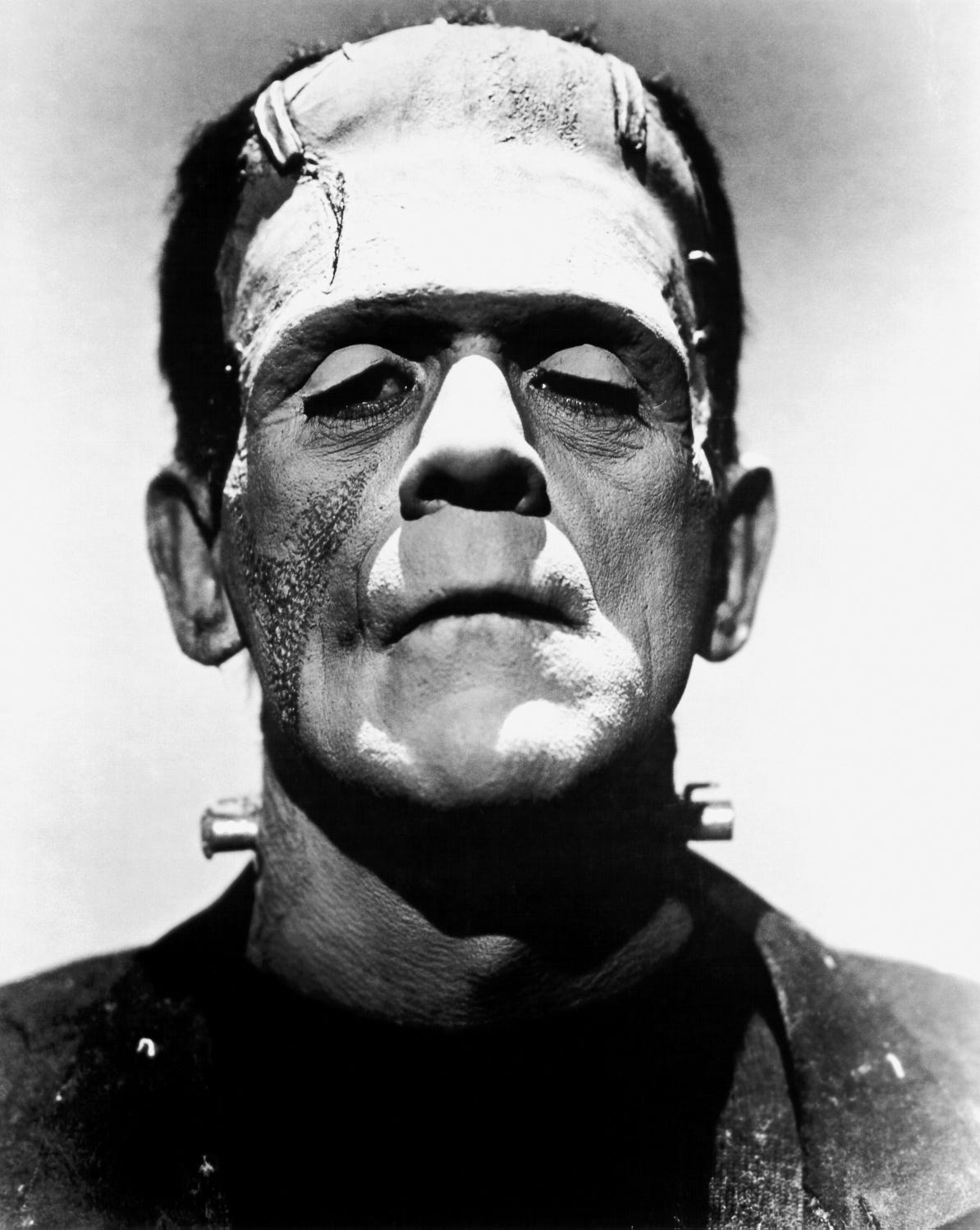
Rather than be thrilled, the ambivalent scientist finds his success a “catastrophe.” Having worked for two years, sacrificing every other aspect of his life, including his physical health, for his hard labors, he now can only experience “breathless horror and disgust”6 at the result. So he flees into his room, and then he rejects his creation in horror when it follows after him. Escaping into the wilderness surrounding Ingolstadt, where its creator has been studying at university, the monster somewhat too-quickly acquires language, culture, and an ethical code by spying on the cottage of an exiled French family. This is the part that modern readers will have the hardest time with—not just because the creature’s moral educators are French, but because we intuitively understand the difficulty and time-consumingness of enculturation. There is no sense in Shelley’s novel (unlike in later retellings beginning with the 1931 Universal Pictures production starring Boris Karloff) that the monster comes pre-equipped with a working, already-enculturated albeit defective brain.
The creature then avenges itself for its creator’s rejection by killing Victor Frankenstein’s brother William and framing William’s nanny for the murder. The nanny is then convicted and hung for the crime. Confronting the scientist, the monster promises to stop its vengeance if he will build for it a companion. After agreeing initially, the scientist changes his mind in another of his moral reversals, and the monster kills the scientist’s best friend and then his bride on his wedding night. Vowing to destroy the monster, Victor pursues it to a cold Northern ocean, but he collapses just short of reaching his quarry and goes adrift on an ice floe. The sublime framing narrative of the novel is that of the polar explorer who rescues the dying scientist and hears his terrible tale—advising the ship captain to avoid all ambition, even that of scientific discovery, since it obviously did him so little good in his short life.
Frankenstein was published, anonymously (common in those days), on the first of January, 1818, with a preface by Percy, who most readers assumed had really written the novel.
Balancing the Ledger
Frankenstein has been interpreted in many ways. It has been read as an expression of John Locke’s philosophy that people, and even monsters, are blank slates, not born good or bad but made that way by circumstances. It has been read as a Jungian or gnostic allegory about the necessity of bringing forth and acknowledging our more irrational nature, our shadow.7 And it has, most famously and most often, been read as a warning about scientific hubris: creating life in mockery of God.
Shelley Biographer Miranda Seymour argues that the clichéd warning-about-playing-God reading of Frankenstein is dubious, given that its author was an atheist who actually believed in the power and promise “Promethean” science. Mary certainly would have welcomed any biomedical solution to undo death, given the grief she had already endured from various losses (her mother, her first child) and would continue to suffer over the coming years. But it is in the very nature of Freudian ambivalence that opposite feelings, attraction and repulsion, can be present in the same creator, or the same work, at the same time. Just as Hollywood has endlessly proved that the best way to glorify war is with an “anti-war” film, virtually all of our supposed scientific cautionary tales—including the Blade Runners and Terminators and Aliens and Jurassic Parks that owe their existence to Mary Shelley—stoke a kind of techno-fetishism, embrace of the materialist worldview and thrill at outrageous and ethically dubious scientific possibilities, precisely by using the narrative vehicle of dire warnings full of moralistic finger-wags. “Your scientists were so preoccupied with whether or not they could, they didn’t stop to think if they should” says Jeff Goldblum’s chaotician Ian Malcolm in Jurassic Park—an easy moralism that permits us to enjoy the spectacle of cloned dinosaurs running amok in the modern world and eating people, without feeling any guilt. Shelley was fascinated and awed at the possibilities of science and at the mechanistic view of life. There may indeed have been regrets associated with her novel, but not for reasons having to do with scientific ethics.
Lest she think herself capable of creation on par with men, let alone God, Shelley felt compelled to list exactly what she took—from her predecessors, from the men in her life, and from her own store of memory—and to publicly reaffirm the impossibility of true creation ex nihilo. The monster, arising from the floor as a single coherent being, yet impossibly showing visible sutures revealing the body parts of different pre-existing individuals, seems like a symbolic premonition of this exact situation.
The plight of the monster, an intelligent and ultimately even moral being rejected by its creator and enduring life as an outcast, is easy to link, mundanely, to Mary’s life experience prior to and during her writing of Frankenstein. Her elopement with Percy had resulted in her complete ostracism from society and estrangement from her own father. Then, the suicide of pregnant Harriet Shelley in December 1816, when she was in the middle of writing her book, cast an even darker shadow over her reputation.8 These circumstances could well have contributed to Mary’s story in the ordinary, linear way. But anyone alert to the possible precognitive dimensions of fiction will also naturally see the author’s sad, haunted, corpse-strewn future as possibly even more relevant. She and Percy would lose two more children in Italy in 1818 and 1819, including William. Readers have long found it strange that she should have given the name of her young child (and of her father) to Victor Frankenstein’s murdered brother in her novel. Percy would then drown off the Italian coast in 1822. Then on May 14, 1824, after a night of intense, inexplicable gloom that she soon recognized as premonitory, she would learn of her beloved friend Byron’s death from fever in the Greek town of Missolonghi, where he had been fighting for that country’s independence.9
Despite her atheism, Mary believed in fate, and she came to believe that her grievous losses were punishment for Harriet Shelley’s suicide death. In reflecting on all the tragedies, she would surely have reflected on her life counterfactually, as one does: What would have happened if she hadn’t run off with a married poet? What sadness might she have spared herself and others? Her debut horror novel was obviously one billiard-ball consequence of that romantic choice, as were the three (of four) children that she had loved and then lost. Frankenstein was at least entangled with her sins and her grief, even if it did not directly cause them. On the other hand, Mary never wrote of feeling regret about her debut novel. In that 1831 preface, she wrote of her fondness for her “hideous progeny” and her happiness to send it out into the world again. So, it is unclear whether or to what extent the horror in her horror novel precognitively relates to these real horrors in her later life. We can make of the violence and death in Frankenstein what we will.
A more compelling case can be made, though, that Frankenstein was really about … Frankenstein—that is, about how the author of this scandalous and unprecedented work of fiction would look back in hindsight on her literary debut and about the role it would play in her later efforts to justify and legitimize herself, both as a writer and as a woman committing the sin of being original.
Another common interpretation of Frankenstein that at least comes closer to what I will be arguing is that it is about the writer’s own mixed feelings about her power of creation.
It is normal for creative people to feel trepidation at their abilities. They feel excitement when they discover they are capable of shaping words or images that have the ability to move people, and this sense of power gives rise to the natural ambition to do it for a living. But along with this excitement and ambition comes hesitation and guilt. The psychoanalyst Otto Rank argued that being an artist, having the gall to express oneself originally, feels like hubris, deserving of nemesis.10 And indeed, this psychoanalytic logic of ambivalence matches the story of Frankenstein quite closely: Victor Frankenstein is nothing if not ambivalent about his creation, repeatedly flip-flopping between wild enthusiasm and regret, arrogance and guilt. If Mary felt such fear at the time she was composing her story, it was justified for reasons beyond the tragedies ahead of her. After it became clear that she and not her poet husband was the author of this spellbindingly original book, she found herself endlessly called upon to acknowledge her story’s various influences and explain how she managed to put them together in a manner that possessed a kind of autonomous inner vitality. It became a constant project: self-justification and accounting—culminating with the preface to that third edition of her novel in 1831, where her famous dream-reverie story first appears.
It was partly a function of the story’s real novelty. No one had ever written anything quite like this, and while it had not initially sold that well, a series of mostly unfaithful stage productions gave it renewed life in the late 1920s. Theaters hired people to picket the performances as immoral, in a successful ploy to draw audiences.11 Suddenly, an increasingly psychologically interested and curious public wanted to know the details of this scandalously dark story’s origins. They wanted to know how a famous creative mind works, just like people do now. But unfortunately, their curiosity was also, mainly, a function of the author’s sex and age: “the question, so very frequently asked me—‘How I, then a young girl, came to think of, and to dilate upon, so very hideous an idea?”12 Lurking behind these questions was undoubtedly a morbid suspicion that her creative imagination, capable of producing such monstrous ideas, might have been related to her equally monstrous morals. After the world learned that she, daughter of dubious atheistic freethinking intellectuals Godwin and Wollstonecraft, had run off with a married freethinking poet, probably driving the man’s pregnant wife to suicide, and spent a summer of sin with him in a villa on the shore of Lake Geneva where all the men, including the famous libertine Byron, had probably slept with all the women (what the tabloids of the time assumed), she had a lot to account for.
And the critics have always tended to be piranhas. The Enlightenment mechanistic view of poetic creation had given a kind of charge and impetus to critics of literature, who could—and were indeed invited to—“derive every rill they behold flowing, from the perforation in some other man’s tank,” as Coleridge bitterly put it in his published preface to the poem that drove Percy Shelley to flee the room in a cold sweat. So, to appease the critics and the doubters, Shelley dutifully, almost piously, recited the standard Enlightenment assumption of creativity as laborious invention utilizing pre-existing associations and influences, underscoring as she did so the impossibility of matching God’s achievement by creating ex nihilo. You can almost hear the crack of the billiard balls hitting each other as she describes:
Everything must have a beginning … and that beginning must be linked to something that went before. The Hindus give the world an elephant to support it, but they make the elephant stand upon a tortoise. Invention, it must be humbly admitted, does not consist in creating out of void, but out of chaos; the materials must, in the first place, be afforded: it can give form to dark, shapeless substances, but cannot bring into being the substance itself. … Invention consists in the capacity of seizing on the capabilities of a subject, and in the power of moulding and fashioning ideas suggested to it.13
And she went on to list many of those suggested ideas, her raw materials, including the various German ghost stories in that book that fell into their hands at Villa Diodati, but also, most importantly, the latest developments in science. She recalled how during those dark and stormy nights by the fire, she was “a devout but nearly silent listener” as Percy and Lord Byron discussed speculations about a life force, about Luigi Galvini’s discovery that an electrical impulse could stimulate frogs’ legs to jerk, and about the discoveries of Erasmus Darwin, who was said to have witnessed the spontaneous coming-to-life of a piece of “vermicelli” in a glass case. Someone in the game of Chinese Whispers connecting Darwin to Mary—it could just as easily have been Byron or Percy or whoever they heard the story from (the account first appeared in the annotations to one of Darwin’s poems)—mis-read or mis-heard the microbe vorticellae, the subject of Darwin’s scientific observations, as vermicelli, a kind of pasta.14 These scientific lines of research and speculation led naturally to the thought, “Perhaps a corpse could be reanimated …”
We have here a curious creative mind, somewhat in awe of her own inventive powers, wrestling with the real problem of where her ideas come from, within a Christian culture and an Enlightenment scientific discourse that in different ways limited the possible answers that could be given. In effect, what Shelley struck was a compromise that would be acceptable to her more conventional readers: I, a girl, could create, but not adequately, not fully, not beautifully. And anyway, what any human can create can only be a hideous parody or mockery of what God (or Nature) can accomplish. You can plainly see—I invite you to see (she seems to be saying)—the sutures where the parts have been sewn together to make something so hideous.
Most readers assume (because they have been told, or because they have gleaned it from one of the later movie adaptations) that reanimating a corpse is the main scientific premise in Frankenstein. But that’s not actually what happens in Victor Frankenstein’s laboratory, nor is it the most original idea in the novel—which it ought to be, if the novel were reducible (as some suppose) to a wish-fulfilling fantasy repairing the author’s own various losses in life.15 Frankenstein is instead about assembling dead body parts taken (stolen) from multiple sources and giving a new and animating coherence to them. Shelley wrote, “perhaps the component parts of a creature might be manufactured, brought together, and endued with vital warmth.”
Creating a single living creature from the stolen parts of separate creatures had little if any precedent in the scientific speculation of the time.16 On the other hand, it had “precedence” in Shelley’s own future: Hauled before the stern High Court of critical thermodynamics, this upstart and immoral young lady, too smart and melancholic for her own good and having spent years in exile, was assumed to have effectively thieved things. Lest she think herself capable of creation on par with men, let alone God, she felt compelled to list exactly what she took—from her predecessors, from the men in her life, and from her own store of memory—and to publicly reaffirm the impossibility of true creation ex nihilo. The monster, arising from the floor as a single coherent being, yet impossibly showing visible sutures revealing the body parts of different pre-existing individuals, seems like a symbolic premonition of this exact situation.
Subsequent biographers and critics have done the expected thing of adding to Shelley’s list of possible or probable influences, multiplying those visible sutures. They have pointed out, for one thing, that the fireside discussions about Galvini and Darwin would not actually have been new to her. As a child, she likely overheard in her father’s home discussions of horrific—but real—experiments by John Aldini involving electrically stimulated cadavers of executed prisoners and the animation of dogs’ severed heads. One of William Godwin’s friends, Anthony Carlisle, had an intense interest in such medical experiments then being conducted.17 And critics have always noted how Coleridge loomed large as an influence too, especially his Rime of the Ancient Mariner. Mary never forgot hearing Coleridge recite that poem in her house when she was nine. She hid under a sofa and listened spellbound as Coleridge wove his dark tale for her father and the other adults in the parlor that night, before her stepmom caught her and sent her back to bed.18
In the novel, after Victor Frankenstein flees from his creation into his room, he has a horrible dream of kissing his fiancée, who turns into the rotting corpse of his mother. The monster then enters his bedroom and approaches:
His jaws opened, and he muttered some inarticulate sounds, while a grin wrinkled his cheeks. He might have spoken, but I did not hear; one hand was stretched out, seemingly to detain me, but I escaped, and rushed down stairs.19
“Seemingly to detain me.” Coleridge’s epic Rime begins when the ancient mariner, a crazed old figure with a mad story to tell, detains the wedding guest outside the church with a hand outstretched on his shoulder, so he can unfold his astonishing tale of supernatural travels and travails. Shelley’s novel is premised not simply on an arrogant scientist’s creation of something awful but on the scientist’s reluctance to listen to that awful thing’s story, to hear of its plight, and to do what it demands to make things right. The wedding guest compelled to hear the mariner’s story is reluctant too, at first. Frankenstein contains other allusions as well as similarities of setting to Coleridge’s poem.
Shelley’s account of her dream reverie is also very much like Coleridge’s famous account of how he composed his other, shorter masterpiece Kubla Khan after an opium dream—which, in fact, Shelley first read at Villa Diodati later that summer, after she had already embarked upon writing her novel. When Byron’s dramatic reciting of the lines from Christabel caused her boyfriend to lose his you-know-what, Mary wrote her half-sister Fanny in England, asking her to send a copy of Coleridge’s newly published volume containing that poem along with Kubla Khan, which had come out just a couple weeks after their departure to Switzerland. Seymour argues that Percy’s reading of Christabel to her, from this volume, was another inspiration for her work in progress.20 But Kubla Khan’s closing lines would have constituted another challenge to the young aspiring writer of horror: The poet expresses his wish that he could resurrect his vision of the Mongol khan’s Xanadu, weaving such spells for his audience that “all who heard should see them there, / And all should cry, Beware! Beware!” and close their eyes “with holy dread.” Dread, holy or even unholy, is the literary effect Mary dreamed of producing.
Because of its similarity to Coleridge’s origin story for Kubla Khan, some biographers including Seymour have disbelieved Shelley’s account of her novel’s origination. “She wrote the 1831 preface in order to help sell the book; telling the best possible story mattered more than the truth.”21 The biographer notes that Shelley’s 1831 account is more dramatic than what had appeared in the preface to the first edition, which had been written for her by Percy, and that her belated claim to have finally been inspired after a period of writer’s block was not mentioned by the late Polidori, history’s other witness to the goings-on in the Villa. Polidori died by suicide in 1821; indeed, all of history’s possible witnesses to her magical creative summer in Geneva, except for Claire, were dead by the time she wrote her third preface. Diary entries and other data suggest that Mary already had in mind to write some sort of sublime novel even before her departure for Switzerland, so Seymour argues she started writing Frankenstein right after Byron issued his challenge and that the “writer’s block followed by flash of inspiration” story was a contrivance meant to resemble Victor Frankenstein’s laborious assembly of his monster in her novel. The biographer calls Shelley’s reverie story a “cool appropriation”22 of Coleridge’s dream account—as though, if one writer gets a good idea, out of the blue, in a drowsy state, it is impossible for another writer to do the same.
Something about vision, the autonomy of mental images, ideas coming to a writer unbidden, the experienced effortlessness and spontaneity of a scene being played in one’s mental theater, is extremely threatening to academic custodians of the literary life.
Seymour says selling books mattered more to Shelley than the truth and that she was a “singularly convincing liar”23 when she wanted to be. But the biographer doesn’t say what she thinks the truth of the novel’s inspiration really was, or why the author’s account of her creative inspiration had to be based on her novel and not the other way around. Was Shelley instead fully awake and alert at her desk, consciously, effortfully, responsibly cobbling together everything she’d ever heard or read that was relevant, perhaps on the era’s equivalent of notecards or Post-It notes? Was she perspiring while she engaged in this heavy mental labor of assembling all the ideas being read and discussed in the villa into a scary but plausible premise that was greater than the sum of its parts? It’s a ridiculous image—although effectively, with her dutiful accounting of her influences, it is what Shelley did go some way toward supplying in 1831.
I don’t believe it. Literary hacks may sit at their desk before a project, mentally or physically listing their influences or materials and calculating how to assemble them into something new-seeming (but that cannot be truly original) in order to satisfy whatever commercial calculation or algorithm. This is in fact precisely what AI now does—it is an algorithmic version of fancy: mixing and matching preexisting ideas and images in an ultimately soulless, meaningless way. Human creators driven by the need to be original know they have to approach the problem differently. You can’t scare readers with an idea they’ve heard before, just reassembling borrowed influences. Thus, I maintain, it would only have been after the fact, when called upon to explain where her idea came from, that the kind of accounting Shelley displayed in her 1831 preface took shape as a story of conscious assembly, where the different components of the idea could be discerned, and she could see some of the ways in which her novel may have been influenced by other things she had read and heard.
In other words, Shelley’s accounting was, and had to be, a hindsight construction; it doesn’t plausibly reflect her actual creative process, least of all her inspiration.
Seymour’s claims about Shelley are typical of the debunking impulse common in academic critics and professional biographers when it comes to matters of inspiration. Something about vision, the autonomy of mental images, ideas coming to a writer unbidden, the experienced effortlessness and spontaneity of a scene being played in one’s mental theater, is extremely threatening to academic custodians of the literary life. But in the hypnagogic and hypnopompic states at the edge of sleep, that’s what happens. Images arise without the feeling of having created them, and persons or personlike beings behave in unpredictable, autonomous ways. Deliberately created but thus inert or dead images spontaneously come alive and begin to do and say things the individual never would or could have thought of consciously.
Shelley notes that it was late when she had her reverie, “after the witching hour.” I don’t believe this is a contrivance for spooky effect. An early follower of Freud, Herbert Silberer, was a pioneer in studying the dreamlike scenes arising on the edge of sleep, in the hypnagogic state, and he noticed that they arise specifically from a combination of fatigue and the effort to think.24 Staying up way after bedtime, but mentally excited by amazing ideas just read or listened to, is exactly when such reveries are liable to occur. The resulting images obey what Sigmund Freud called “primary process” thinking (Coleridge had called it the primary imagination), and this state has supplied myriad writers, artists, and inventors with some of their best ideas. German Chemist August Kekulé, who claimed to divine the ring structure of benzene from a drowsy vision of snakes eating their tails, is probably the most famous example of hypnagogic creation. Edison, despite his quip about perspiration, actively used this most inspired state of (un)consciousness to mine ideas.25 Salvador Dali, too, used the hypnagogic state to get ideas for his paintings. And indeed, sometimes hypnagogic images are so startling that they shock or scare the dreamer awake.
In 2011, Texas State University astronomer and art-history sleuth Donald Olson went to Geneva with some colleagues and students to investigate Shelley’s story, based on a tiny detail about the vividly remembered moon “struggling through” the closed shutters right after she had her reverie. Visiting the room, studying the view, and doing astronomical calculations for the summer months of 1816, the team determined that the moon would have indeed been in a position to shine directly through the shutters of Mary’s room on a single early morning that summer: between 2AM and 3AM on June 16. This would be exactly consistent with Shelley’s story. Polidori recorded in his diary that Byron and Percy had a “conversation about principles” earlier that night, on the evening of June 15.26 Again, Mary recalled that her creative breakthrough came after the men discussed the “principle of life.” So, the chronology (at least) is corroborated.27
Appropriately for a story written in response to a challenge to write a ghost story, I think the afterlife of Frankenstein is its real backstory: The novel foretells how its author would experience the myriad demands to account for her inspiration and her sources after her novel was published, using that word “account” with its richness of cultural, economic, and physical connotations. The novel’s primal scene, the monster assembled of dead parts suddenly coming to life, was an effect of the author’s later reconstruction of her creative process, not the other way around.
That Shelley’s premonition of her hindsight accounting came in hypnagogia makes abundant sense. Silberer argued, from studying his own hypnagogic images, that they are “autosymbolic,” representing in image and symbol what waning verbal reason is thinking right at that moment. Anecdotally, though, such states on the edge of sleep are highly fertile for precognition.28 Dreamworkers with the patience to defy their drowsiness and write down what they experience during this liminal dream state sometimes find that such pre-dreams symbolize some subsequent (frequently but not always imminent) situation in waking life.29 Mini-narratives culminating in some loud noise, which convinced the Russian Cosmist polymath Pavel Florensky of the “inside-out” temporality of dreams, often are hypnagogic scenes. An argument can be made that this is how it really worked with Silberer too: that his hypnagogic imagery could really have been pre-presenting what he was about to explicitly formulate seconds later in his recollection of “what I was just then thinking.” Similarly, the notorious creative solutions arising in this state may really be precognitive of the success of those solutions. As precog writer Philip K. Dick observed in a 1974 letter musing on the time-looping nature of creativity, the future is wiser and more knowledgeable than the present—it has the benefit of hindsight.30
All prophecy must on some level be self-fulfilling, because backwards-pointing causal arrows influence the past, and thus become part of the backstory of the future. It means that, really, new ideas have no origins in history.
If inspiration precognizes the creator’s hindsight reflections on inspirations’ fruits, it would help explain why so many inspired works take the form of metaphors of astonishing profusion, like rivers, surging tides, animal stampedes, and words flowing out like endless rain into paper cups. The effortless, rainlike or riverlike creative imagination can only be reflected upon as riverlike once it becomes noticed as such, in its immediate aftermath, and it calls for a metaphor. It would be that metaphor—a product of awake, albeit poetic thought—that is being precognized. In this sense, an inspired work could be precognitive of the artist’s awe reflecting back on their creative flow state seconds or minutes (or hours or days or years) later, not a simultaneous production of images to illustrate verbal ideas being produced, or words flowing obediently rainlike or riverlike to caption some spontaneously arising thought-image.
Coleridge’s primary imagination could be essentially premonitory of the more awake and deliberate secondary imagination, in other words. That would be another way of formulating my hypothesis in Time Loops that the Freudian unconscious is future consciousness displaced backward in time.
Impossible Objects
Since the Enlightenment banished any and all ideas of teleology from our sciences and our psychology, any notion of the artist—even the sci-fi writer—as a prophet has been reduced to the figurative sense of prediction by means of inference. But even if the psychologists and the biographers and critics in terrestrial humanities departments have been slow to get the memo, the inspiring truth revealed by the discoveries of Einstein over a century ago is that the past is not the only place objects, energy, and information can come from. Recent discoveries in quantum computing and quantum biology are suggesting that information might really flow from the future toward the past within individuals’ quantum brains. Again, the mysterious uncertainty of the quantum world is where that retrograde information flow may have been lurking all this time.
The implications of such a possibility go way beyond just getting previews of future events in dreams and art. What is doubly or triply scandalous to our Enlightenment sensibilities is the circular nature of causation and creation in a universe that includes information traveling backward in time. All prophecy must on some level be self-fulfilling, because backwards-pointing causal arrows influence the past, and thus become part of the backstory of the future. It means that, really, new ideas have no origins in history.
To understand this (or at least, visualize it), we need a theory of time machines. Fortunately, the hideous literary genre Frankenstein birthed, science fiction, ended up giving us such a theory. H. G. Wells is usually credited as the first explorer of this idea, although the conundrums of causality were not really of interest to him, and there is nothing in The Time Machine that would provoke thoughts of paradox. But four years before The Time Machine, a journalist named Edward Page Mitchell had penned an anonymous story for a boys’ magazine about a history student with a time-traveling clock that brings him to the 1574 Spanish siege of Leiden. The student is able to save the Dutch inhabitants of the city using his foreknowledge of how the battle unfolded. “The Clock That Went Backward” was both the first time-machine story and the first to explore the idea of the future influencing the past without causing paradox—in other words, the time loop.31
Pulp writers couldn’t get enough of the idea of time loops, and countless stories were written on this theme in the early and mid-20th century. My favorite is William Tenn’s 1955 short story, “The Discovery of Morniel Mathaway.” A far-future art historian named Glescu travels back to 20th-century Greenwich Village to study the work of an admired painter, Morniel Mathaway, only to find that the man is not a painter but a thief, who steals his time machine. Glescu is forced to assume the identity of Mathaway and live out his life reconstructing the paintings from his own book. Disturbingly, there is no point in Glescu’s life where he “came up with” the ideas for his paintings—they were just remembered from his “past” (in the future). A similar, more recent example comes from the German television series Dark: A time traveler from the future gives clockmaker H. G. Tannhaus a book, Eine Reise durch die Zeit (A Journey Through Time), written by his older self. The book gives him the needed knowledge to build the time machine that eventually enabled this time-traveler’s journey … and to write his book. But just like in Tenn’s story about Glescu/Mathaway, where did the knowledge in the book come from? There is no point in Tannhaus’s life when the secret to time travel was figured out, like with furious scribblings on a chalkboard. The solution was just given to him, by his older self, who got it from his younger self, in a loop.
Scenarios like this are frequently cited among the objections to the possibility of time travel, because they raise the specter of things (including new ideas) arising ex nihilo, bootstrapping themselves into being. It is often called the “bootstrap paradox,” although paradox is a misnomer. Unlike the more famous grandfather paradox—changing past history in a way that forecloses the existence of the time traveler or the possibility of their journey—there is no law or principle that would prevent things from causing themselves. Causal circularity is really what logicians call tautology, and while it troubles our linear sensibilities and is frowned on in debate class, bootstrapping of one sort or another would be the norm in a universe that allows time travel or even just backwards causation. And both the Einsteinian universe and quantum physics do, in principle.
In a 1992 article on the possibility of time machines, Russian theoretical physicists Igor Novikov and Andrei Lossev called objects or information arising from the nothing of a time loop “Jinn,” after the beings of Arabic mythology that sometimes just appear out of nowhere.32 Novikov, one of the leading thinkers on the subject of time travel and an advocate of the idea that a universe with time machines in it will always find some way to be self-consistent, thinks Jinn are a real, unproblematic effect of time travel. There is some reason to think that the world could even be made of Jinn, when you drill down. For instance, empty space is a seething foam where pairs of particles and antiparticles come into existence from nothing and then crash together again, releasing enormous energy in the process. One hypothesis is that these particle-antiparticle pairs could be tiny time loops: The antiparticle could be itself, traveling backward in time. A pair of objects having opposite properties coming out of nowhere and then merging and disappearing again is exactly what a single time-looping object would look like.
Frankenstein’s monster is the original Nowhere Man, a sublime being having literally bootstrapped itself—heavy, clunky boots in this case—into existence. It really has no origins. It is something that shouldn’t be, shouldn’t live, yet does live—and pursues and terrorizes its ambivalent creator to give an accounting, “how?”
Causal loops could also point toward an answer to one of the biggest questions in biology: how life arises, or arose, from lifeless entropic processes in a thermodynamic universe where any defined system loses energy. Some yet-unknown life force like French philosopher Henri Bergson’s élan vital, English biologist Rupert Sheldrake’s “morphic resonance,” or perhaps some “syntropic” principle magnetizing things toward order, have long been proposed as an answer, but these have remained empty coinages, mere handwaving.33 But if future states of affairs constrain or retro-determine what looks to our present-bound eyes simply as random behavior of matter at the quantum scale, and this future constraint can scale up in complex organic molecules, then it offers a possible answer to how order (and even meaning) can emerge within that thermodynamic world.34 The character of natural law might arise from the very convoluted way things must unfold in the self-consistent universe of Novikov, which includes beings that have both free will and a glimmer of foresight.35
Bottom line: The ouroboroses that fascinated the ancient mystics and beguiled the snoozing Chemist Kekulé are not paradoxical, nor is the kind of bootstrapping that is starting to look like the rule in physics rather than the exception. Being might even be bootstrapping, in the end.36 This self-causing nature of physical reality on the smallest scales provides a model, I believe, of what happens with “higher” forms of creation and creativity too: Nowhere when you drill down into the billiard-ball world of electrical and chemical messages criss-crossing a cortex may we ever find a “laborious” origin to an idea, the way we imagine if we have a mental picture of cognition as “cogs,” or thinking as some inner imp or homunculus toiling in an inner workshop or scribbling at a chalkboard, assembling new knowledge and insights from the raw materials of prior learning. Products of the precognitive imagination can arise from nothing. It is exactly what Shelley struggled to say that, as a mere mortal, she couldn’t quite do, while mumbling nervously under her breath, “but it happens.”
If this is a correct assessment, then it is not just a minor add-on or supplement to the usual interpretive or critical assumptions. The reality of time loops and the bootstrapping of ideas into existence from nothing calls into question all our taken-for-granted beliefs about originality in the realm of culture. It compels me to ask: Might the creative germ or spark that gives rise to a novel, or a film, or a sculpture, or a song, or a new scientific theory or insight, always ultimately have such a non-origin? Far from diminishing the creative act, it would elevate the artist and the thinker beyond even the misty crags and snow-topped peaks of the Romantics’ imaginations. It would elevate the creator to the status of a god. And since in one way or another we are all creators—engaged in the constant artistry of living—it would have to really be true for all of us.
Such an idea is bound to provoke resistance, if not complete dismissal. As I argued in From Nowhere, creation ex nihilo upsets our deeply ingrained Protestant-ethic assumptions that creation should be “99 percent perspiration.” We naturally feel that someone or some thing, even God, needs to have labored to create some idea or some piece of art or writing. We call it a “work” for that reason. More generally, we want things to be linear and to have causes that can be credited. It is likely these kinds of anxieties that underlie Seymour’s wish-demand that Shelley not have just “gotten” the premise of her debut novel in a hypnagogic reverie but somehow actively constructed it in some purely rational, deliberate, premeditated, thus guilty way.
There is a fundamental tension in art, between making and finding. It has an ontogenic correlate or precursor in the earliest play with what the child psychologist D. W. Winnicott called transitional objects. Winnicott regarded early attachment objects like blankets and stuffed animals as the first, pre-linguistic symbols, standing in and substituting for caregivers and the complex feelings of security and attachment associated with them. All later artistic feeling and creative impulses grow out of such play, Winnicott argued. Interestingly, children’s play with transitional objects often involves destruction and recovery, playing “gone” with them so that the child can experience the pleasure of discovery. It was such play that Freud first identified in his classic 1920 work on trauma and death, Beyond the Pleasure Principle: Freud’s grandson Ernst used to cast a spool out of his crib (exclaiming “gone” or “fort” when he did so) and then draw it back, savoring its arrival (saying “there,” or “da”)—a repetitive game to master the early childhood trauma of his mother’s going-away. Toys are made gone so they can be found.
Until that point in Freud’s life, when the terrible psychological sequelae of World War I forced him to confront the phenomenon of the repetition-compulsions, his theory had been centered on the individual’s seeking of pleasure. But what struck him about Ernst’s fort-da game was that it was the fort part (not the da) that brought the child the most satisfaction. Somehow there is a pleasure in destruction or negation, including self-abnegation. As he got a little older, Ernst played the same game with his own reflection in a mirror—he liked to play gone with himself. From this, Freud formulated the theory of the “death drive” (or Thanatos) that operates counter to the pleasure principle. The psychoanalyst Jacques Lacan used a handy French word, jouissance, to describe this compulsive pleasure-in-pain or pleasure-in-negation. Usually translated as “enjoyment,” it is an equivocal enjoyment that underlies neurotic obsessions and addictive behavior of all kinds. And it is arguably this feeling of pleasure-in-(self-)destruction that “scales up” as the philosophical or aesthetic mood of the sublime, as first formulated in the writings of Immanuel Kant. The sublime, with its recurring tropes of destruction leaving behind some relic or remainder, was again the favorite mood of the Romantics.
I have argued elsewhere that the sublime is really at the root of premonitory and precognitive experiences of all kinds. And it is uncanny that Freud centered his thinking about death and trauma on this little scene in his grandson’s life where he “played gone” with a symbolic stand-in for his mother. Right after he drafted his book, Freud’s daughter Sophie, Ernst’s mother, died from Spanish Flu—a permanent and traumatic “going away” for the child, and a grievous loss for Freud. Sublimity in art or thought may indeed be another of those biomarkers of the precognitive imagination. The quintessential sublime painting, Caspar David Friedrich’s 1823 Das Eismeer or The Sea of Ice, about a wholly fictitious arctic wreck of one of the real Admiral William Parry’s ships, may for instance have been a premonition of a wreck of one of the ships under Parry’s command while searching for a Northwest Passage just a year or two after Friedrich created his work.37
Both in dreams and in art, the sublime often manifests in “impossible” objects. Just as many works by M. C. Escher are impossible in spatial terms—staircases that circle back to themselves and so on—the impossible objects reflecting the time-looping nature of precognitive dreams and prophetic art are impossible in time. Like Ernst’s spool, impossible objects disappear before appearing. Works examined in other chapters of Where Was It Before the Dream? are full of temporally impossible objects: The ring in Tolkien’s The Hobbit and the Door in the Law from Kafka’s novel The Trial are a couple examples. It is such objects that may arise in a moment of inspiration, compelling the writer to build around it some realistic or at least rational premise, like an irritant in the flesh of an oyster, causing it to secrete a protective (and beautiful) pearl: the work as a whole.
The monster in Frankenstein is an impossible object such as we might encounter in an M. C. Escher drawing, encoding and embodying its own from-nowhere and from-nothing impossibility. Consider the most surprising aspect of Shelley’s novel—surprising, at least, from the point of view of a first-time reader expecting a scene like out of any number of movie adaptations where lightning is harnessed à la Benjamin Franklin or some massive steampunk switch is thrown in that tempest-tormented laboratory attic. Shelley never shows us the mechanism, the means of imparting life to the monstrous thing the “pale student of unhallowed arts” has assembled in secret. Despite two centuries of readers assuming it is electricity, it plainly isn’t—other than the purely metaphoric sense of a “spark of life.” Shelley knew enough about electricity’s role in biology experiments that if she intended it to be electricity, she could have said so. No, she leaves the vital principle vague, hidden by the conceit that it is too dangerous to reveal, too horrible and immoral. We are not shown a cause of the creature’s coming-to-life, nor even (to Shelley’s lasting credit) treated with some hand-wavy science-fictional jargon.
But there’s a clue: Victor Frankenstein says that it is somehow the analysis of life and not its synthesis that gives rise to the living monster. “To examine the causes of life, we must first have recourse to death.” It is this reversal of the usual sequence lifedeath that produces his breakthrough epiphany:
I saw how the fine form of man was degraded and wasted; I beheld the corruption of death succeed to the blooming cheek of life; I saw how the worm inherited the wonders of the brain. I paused, examining and analysing all the minutiae of causation, as exemplified in the change from life to death, and death to life, until from the midst of this darkness a sudden light broke in upon me—a light so brilliant and wondrous, yet so simple, that while I became dizzy with the immensity of the prospect which it illustrated, I was surprised that among so many men of genius, who had directed their inquiries towards the same science, that I alone should be reserved to discover so astonishing a secret.38
Somehow it is through death, via decomposition (one almost wants to say, deconstruction), that the monster is brought to life. The monster is a being who comes alive somehow as a result of its source materials being taken apart, born as a result of their decay, not unlike a maggot. It sounds like a paradox—or, an effect happening before a cause. And the truth, once revealed to the scientist, is dizzying with its immensity—a sublime trope right there. Frankenstein’s monster is the original Nowhere Man, a sublime being having literally bootstrapped itself—heavy, clunky boots in this case—into existence. It really has no origins. It is something that shouldn’t be, shouldn’t live, yet does live—and pursues and terrorizes its ambivalent creator to give an accounting, “how?”
The monster is effectively a representation, right within the novel, of the exact impossibility I argued for: that it was the creator’s (Shelley’s) analysis of her work that gave rise to the work. Victor Frankenstein’s haunting of graveyards and charnel houses to acquire his materials suggests the immorality of this creative process. But the immoral is just one of many ways of reframing and experiencing the impossible, enabling us to grasp its contours if not see it directly. Creation ex nihilo is literally unthinkable—human cognition being somehow accountant-like, we literally seem to lack the ability to conceive of something that has no origin—so we shift to some moral idiom like graverobbing to brand it as antisocial instead. But really, it must apply to all “original thoughts” we have. There is no ultimate source of any idea. Nor do we will ideas into being—which would imply having an idea for the idea, in an infinite regress. Ideas really arise from nothing, from the substance of our lived lives, our looping biography. There is no one point in that biography when a new idea is born—there must be a loop. Ideas emerge as a dramatic, symbolic transfiguration of a loop in the life.
So, in short, beyond seeing Frankenstein as a warning (but with a wink) about the hubris of science, I think the novel reflects a startlingly insightful poetic-imaginal truth about the impossibility of things created by means of the precognitive imagination. Young god Mary Shelley, age 18, received the plans for her debut novel—at least, its core premise—from her older self, who received it from her younger self. She would not have been called upon to give an accounting of her creative process and her conception of the imagination had she not imagined and then written a super-original, dangerously original story; but the core, the nucleus, of her story, its impossible premise, which came to her one night in a hypnagogic state, was a premonition of that hindsight accounting.
Read More! Where Was It Before the Dream? is a heretical book of literary criticism that upends the usual academic assumptions: that influences flow from the past. Now available on Amazon.
References
Miranda Seymour, Mary Shelley (New York: Grove Press, 2000), 157.
Mary Shelley, Frankenstein (New York: W.W. Norton, 2012), 167.
Ibid.
Ibid., 168.
Ibid., 35.
Ibid., 36.
Matt Cardin, “The Task Enjoined by Heaven,” The Living Dark, October 12, 2022, https://mattcardin.substack.com/p/the-task-enjoined-by-heaven#footnote-1.
Shelley also saw the effects of a somewhat outcast life in her illegitimate half-sister Fanny Imlay, who, possibly suffering depression, died by suicide in December 1816.
Seymour, Mary Shelley.
Otto Rank, Will Therapy & Truth and Reality (New York: Alfred A. Knopf, 1968).
Seymour, Mary Shelley.
Shelley, Frankenstein, 165.
Ibid., 167.
Glenn Branch, “Vermicelli and Vorticella,” National Center for Science Education, accessed on October 5, 2024, https://ncse.ngo/vermicelli-and-vorticella.
Victor Frankenstein does perceive that his experiment could be a kind of preamble and practice for the medically laudible task of reviving the dead—and Shelley herself did confront that theme in her story “Roger Dodsworth: The Reanimated Englishman” (which, incidentally, gave the world the term “suspended animation”).
As Chris Baldick shows, “wholes greater than the sum of their parts” had however become a recurring theme in philosophy. See Chris Baldick, “Assembling Frankenstein,” in M. Shelley, Frankenstein (New York: W.W. Norton, 2012).
Seymour, Mary Shelley; Richard Holmes, “The Power of Contemporary Science,” in M. Shelley, Frankenstein (New York: W. W. Norton, 2012).
Seymour, Mary Shelley.
Shelley, Frankenstein, 36.
Seymour, Mary Shelley.
Ibid., 158.
Ibid.
Ibid., 408.
Herbert Silberer, “Report on a Method of Eliciting and Observing Certain Symbolic Hallucination-Phenomena,” in D. Rapaport (ed,), Organization and Pathology of Thought (New York: Columbia University Press, 1959).
Andreas Mavromatis, Hypnagogia (London: Thyrsos Press, 1987).
Tim Radford, “Frankenstein’s Hour of Creation Identified by Astronomers,” The Guardian, September 25, 2011, https://www.theguardian.com/books/2011/sep/26/frankenstein-hour-creation-identified-astronomers.
The fact that Shelley had never written about her reverie before 1831 is no counterargument. In 1818, nobody even knew who she was or that she was the author of Frankenstein. Percy, she admitted, wrote that preface for her. It took time for the questions to be asked. It would have been the worst presumption, I imagine, for an unknown, first-time author to imagine readers wanting to know how she’d come up with such an original story before the reading public had a chance to tell her it was original. And indeed, as she may have feared, the reviews initially were not generally positive.
Mavromatis, Hypnagogia.
Eric Wargo, Precognitive Dreamwork and the Long Self (Rochester, VT: Inner Traditions, 2021). The term “liminal dream” comes from hypnagogia researcher and writer Jennifer Dumpert; see Jennifer Dumpert, Liminal Dreaming (Berkeley, CA: North Atlantic Books, 2019).
Philip K. Dick, The Selected Letters of Philip K. Dick—1974 (Novato, CA: Underwood-Miller, 1991).
Paul Nahin, Time Machines (New York: Springer-Verlag, 1999).
Andrei Lossev, Igor D. Novikov, “The Jinn of the Time Machine: Non-trivial Self-Consistent Solutions,” Classical and Quantum Gravity 9 (October 1992): 2309-2321.
Henri Bergson, Creative Evolution (New York: Random House, 1944); Ulysse Di Corpo, Antonella Vannini, Syntropy (Princeton, NJ: ICRL Press, 2015); Rupert Sheldrake, Morphic Resonance (Rochester, VT: Park Street Press, 2009).
Michael Silberstein, W. M. Stuckey, Timothy McDevitt, Beyond the Dynamical Universe (Oxford, UK: Oxford University Press, 2018); Eric Wargo, Time Loops (Charlottesville, VA: Anomalist Books, 2018).
The non-contradiction of things, called in physics the Novikov self-consistency principle, could be a fundamental “force” in nature. I elaborate on this idea in Eric Wargo, Becoming Timefaring (Fairfax, VA: Cup + Saucer Press, 2025).
Temporal bootstrapping may turn out to be the secret of life’s arising from lifeless organic molecules—an idea suggested by physicist Paul Davies. See Paul Davies, The Goldilocks Enigma (Boston, MA: Mariner Books, 2006).
Eric Wargo, From Nowhere (Charlottesville, VA: Anomalist Books, 2024)
Shelley, Frankenstein, 31-2.
Reading this after watching inland empire has sprouted some green shoots in my brain. perhaps the ultimate precognitive time loop is the seed’s passage into a tree and back again. I’m reminded of a delightful heidegger bit about bridges creating the banks they connect…I believe its quoted in hyperculture by Han as well. This is a wonderful piece of writing, thank you!
...I have read hurriedly the rest of the essay so I will comment more later. I wanted to see whether The Last Man was in it. 1826. In this novel of MS the SIBYL of all people is the narrator of a future plague that wipes out everyone except for this one guy...so MS was highly aware of the possibility of time loops...